Aerial lift parts cover every replaceable component on boom lifts, scissor lifts, telehandlers, and vertical mast lifts, from joystick controllers and control boards to hydraulic cylinders, filters, tires, and safety decals. Ordering the right part comes down to one skill: identifying the machine precisely before anything else. This guide explains how to do that, which parts fail most often on each machine type, and how to keep a down machine from becoming a down crew. AirWorx represents equipment brands including JLG, Genie, Skyjack, SkyTrak, Lull, Snorkel, and AXCS, and supports parts customers from branches in Indianapolis, Fort Wayne, and Warsaw, Indiana, and Flora, Illinois, serving contractors, rental fleets, and maintenance departments across both states.
To order the right aerial lift part: read the machine’s full model and serial number from the data plate, describe the failing component clearly, and send photos of the component, its connections, and any printed part number.
What information do you need before ordering aerial lift parts?
Three things resolve almost every parts request: the machine’s full model number, its serial number, and a clear description of the failing component. The model narrows the family, the serial number pins down the exact production configuration, and the description tells the parts specialist which system to look in.
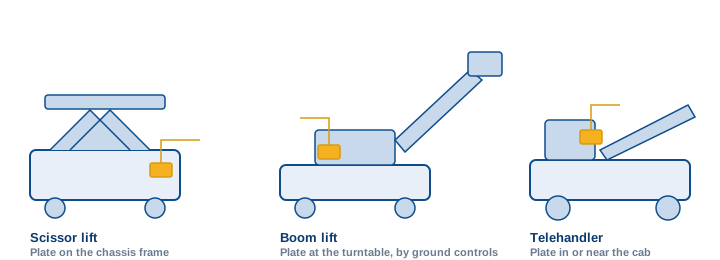
The model and serial number live on the machine’s data plate. Where to find it varies by machine type:
- Boom lifts: usually on or near the turntable, close to the ground control station, where it is visible to someone standing at the lower controls.
- Scissor lifts: typically on the chassis frame, often near a ladder or the ground control box.
- Telehandlers: commonly inside the cab or on the frame near the cab entry.
If the plate is damaged, painted over, or missing, most manufacturers also stamp the serial number directly into the chassis or frame. On many machines that stamp sits near the plate’s original location. A parts specialist can tell you where to look for a specific brand.
Serial numbers matter more than most people expect. Manufacturers revise machines continuously during a production run, so two units with the same model name can use different controllers, hydraulic fittings, or wiring harnesses depending on where they fall in the serial range. These serial breaks are why a parts counter always asks for the number even when the model seems obvious.
Photographs close the gap when identity is uncertain. Useful photos show the whole component, its connections, any printed part number or label, and, for hoses, both end fittings and the routing.
Common aerial lift part categories
Most parts requests fall into six systems. Knowing which system your problem lives in speeds up every conversation with a parts counter.
Electrical and control components. Joystick controllers, platform and ground control boxes, membrane switch panels, control modules, limit switches, proximity switches, foot switches, relays, harnesses, and alarms. Joysticks and limit switches are among the highest turnover parts on any lift because they take physical abuse every shift. Before replacing an expensive control module, rule out the cheap causes first: battery condition, corroded connectors, damaged wiring, blown fuses, and stuck interlock switches.
Hydraulic components. Pumps, drive and lift motors, cylinders, seal kits, valves, hoses, and fittings. When a cylinder weeps or a function gets slow, the seal kit is often the fix rather than the whole cylinder. When a hose fails, look at why: abrasion, bad routing, or a missing clamp will take out the replacement too.
Drive and chassis parts. Tires and wheel assemblies, wheel motors, hubs, brakes, steer components, and pothole protection hardware. Tire spec matters: solid, foam-filled, and pneumatic tires are not interchangeable on most machines, and indoor work usually calls for non-marking compounds. Confirm size and compound from the data plate or the existing tire’s markings.
Platform and safety items. Gates, latches, rails, lanyard anchor points, alarms, beacons, and the full decal set. Safety decals are genuine replacement parts. Machines fail inspections over missing or unreadable decals, and the correct set changes by model and serial range.
Batteries and charging. Deep-cycle batteries, on-board chargers, contactors, and cables for electric scissor lifts and electric booms. Chargers are voltage and chemistry specific, and a mismatched charger shortens battery life quickly. Slab scissors commonly run 24V systems while larger machines differ, so confirm the voltage from the machine before ordering.
Engine and fuel system parts. Filters, belts, pumps, injectors, sensors, and tune-up components for diesel and dual-fuel machines. Air, oil, fuel, and hydraulic filters are the steady consumables here, and stocking a filter set per machine avoids the most common cause of small downtime.
How do parts differ between boom lifts, scissor lifts, and telehandlers?
The systems overlap, but each machine type has its own wear profile.
| Machine family | Example models |
|---|---|
| Articulating booms | 340AJ, 450AJ, 600AJ |
| Telescopic booms | 400S, 460SJ, 600S |
| ES scissors | 1930ES, 2030ES, 2632ES |
Boom lifts add everything the boom itself needs: wear pads between telescoping sections, boom cables, rotation bearing and drive components, jib parts, and platform level sensors. Wear pads are a classic boom consumable; slop or noise in the telescope is often pads, not structure.
Scissor lifts concentrate wear in the stack and the deck: scissor arm pins and bushings, slide blocks, deck extension rollers and latches, and pothole guard mechanisms. On electric models, batteries and chargers are the number one lifetime cost after tires.
Telehandlers, also listed as telescopic forklifts, are closer to rough-terrain forklifts: attachment and carriage components, forks, boom wear pads, axle and transmission parts, and cab components join the usual hydraulic and electrical lists. Our brand guides for SkyTrak and Lull cover telehandler parts in detail.
Should you buy OEM or aftermarket aerial lift parts?
OEM parts are built to the original specification and are the default choice for safety-critical systems, complex electronics, warranty-sensitive repairs, and any component with multiple serial-range revisions. The documentation trail also stays clean, which matters when a machine is inspected or resold.
Aftermarket and remanufactured parts can make sense for commodity wear items: filters, tires, batteries, some hoses, and hardware. The judgment call rests on fit, published specs, warranty, and the cost of being wrong. A cheaper component that strands a machine or muddies a diagnosis is not cheaper. A good parts counter will tell you honestly where aftermarket is fine and where it is a false economy, and that judgment is a large part of what you are buying from a dealer.
How do annual inspections drive parts needs?
Aerial work platforms in the United States operate under the ANSI A92 standards, which call for documented frequent and annual inspections alongside the daily pre-start checks operators already perform. Inspection findings are a steady source of parts demand: worn wear pads, out-of-spec tires, non-functioning alarms and beacons, damaged gates and latches, leaking cylinders, and incomplete decal sets all surface during annuals.
Planning parts around the inspection calendar beats reacting to it. If your annuals cluster in the same season, ordering predictable wear items ahead of the inspection window keeps machines from sitting failed while parts ship. AirWorx service performs these inspections and can pair the findings with a parts order in the same visit.
- Full model designation from the serial plate
- Complete serial number (from the plate or the frame stamp)
- Part number from the failed component, if a label or casting shows one
- Photos: the component, its connections, and its position on the machine
- The symptom in plain words: what the machine does and does not do
How do you keep downtime short when a machine goes down?
Speed comes from the quality of the first call. The requests that resolve fastest include the model, the serial number, the symptom described plainly, and photos. “Platform controls intermittently lose power” points a specialist somewhere specific. “Need a controller” does not.
Two more habits help. First, when a part is identified, ask what should be replaced or inspected alongside it: seals, fasteners, filters, or the wear item that caused the failure. Second, keep the invoice, part number, and machine serial together in the maintenance record so the next order for that machine starts from a known configuration.
When the repair itself is the bottleneck, AirWorx runs factory-trained technicians out of every branch and keeps a fleet of service trucks available around the clock for on-site work. And when a repair will hold a machine out of service during committed work, rental coverage bridges the gap: AirWorx rents boom lifts, scissor lifts, and telescopic forklifts from all four branches, so a down machine does not have to mean a down crew.
Parts guides by brand
Each guide covers that brand’s machine families, how to identify parts for them, and what commonly needs replacing:
- JLG parts (start here): boom lifts, scissor lifts, and the broader JLG family
- Genie scissor lift parts: GS-series slab and rough terrain scissors
- Skyjack scissor lift parts: SJIII and related electric scissors
- SkyTrak parts: SkyTrak telehandlers, built by JLG
- Lull parts: Lull telehandlers, including legacy models
Frequently asked questions about aerial lift parts
What is the serial number and why does every parts request need it?
The serial number identifies the exact machine as built, including mid-production revisions that change which parts fit. Two machines with the same model name can take different components, so the serial number is the only reliable key.
Where is the data plate on an aerial lift?
On boom lifts, look at the turntable near the ground controls. On scissor lifts, check the chassis frame. On telehandlers, check the cab area. If the plate is gone, the serial number is usually stamped into the frame.
Can AirWorx get parts for brands it does not sell?
Yes. The parts team sources components across the major aerial lift and telehandler brands, not only the lines AirWorx represents. Availability varies by brand and age of machine.
What parts should we keep in stock for our own fleet?
For most fleets: a filter set per machine model, common hydraulic seal kits, spare limit and foot switches, and batteries or chargers for electric scissors. Your usage history is the best guide, and a parts specialist can help build a stocking list from it.
Do you support customers outside Indianapolis?
Yes. Branches in Indianapolis, Fort Wayne, and Warsaw cover Indiana, and the Flora branch covers southern Illinois. Parts ship or transfer between branches, and the service fleet works on site across the region.
What if we cannot identify the failed part at all?
Send photos of the component, its connections, and the data plate. If it still is not clear, AirWorx service technicians can diagnose the machine at a branch or on site, then order from the confirmed diagnosis.
Need a part identified? Send the model, serial number, and photos to the AirWorx parts team, or call the parts line at 317-324-3878 for urgent needs.