Lull telehandlers are no longer built, and the machines are still everywhere, which tells you something about how they were made. Crews held onto them for the transfer carriage: the boom assembly slides horizontally, letting an operator place a load with precision that ordinary telehandlers need repositioning to match. Keeping these machines running is a parts-supply question more than a capability question, and that is what this guide covers: identifying legacy Lull machines correctly, the components that keep them working, and how parts flow now that Lull lives inside the JLG family. AirWorx sources Lull parts from branches in Indianapolis, Fort Wayne, and Warsaw, Indiana, and Flora, Illinois.
To order the right Lull part: record the full model, including Series II where it applies, and complete serial number from the data plate or frame, then send the symptom and photos of the actual component, its connections, and its mounting.
Which Lull machines does this guide cover?
The models still common in the field are the 644E-42, the 944E-42, and the 1044C-54, including Series II versions. The numbers follow the telehandler convention: capacity and reach, so a 944E-42 is a 9,000 pound class machine with a 42 foot boom, and the 1044C-54 lifts 10,000 pounds to 54 feet. Older Highlander-era machines still turn up too, and the identification method here applies to them as well.
| Model | Capacity | Reach |
|---|---|---|
| 644E-42 | 6,000 lb | 42 ft |
| 944E-42 | 9,000 lb | 42 ft |
| 1044C-54 | 10,000 lb | 54 ft |
Lull was folded into JLG, which is the single most useful fact for anyone maintaining one today: parts availability runs through the JLG network rather than through a defunct manufacturer, and some components are shared with SkyTrak and JLG telehandlers of the same era. A steering joint or tie rod listing will often name Lull, SkyTrak, and JLG models on the same line. If your fleet mixes these brands, our SkyTrak parts guide covers that side.
How do you identify the right Lull part?
The data plate is in the cab area or on the frame near the cab; record the full model, including Series II where it applies, and the complete serial number. If the plate is gone after decades of work, which is common on these machines, find the serial stamped into the frame before calling.
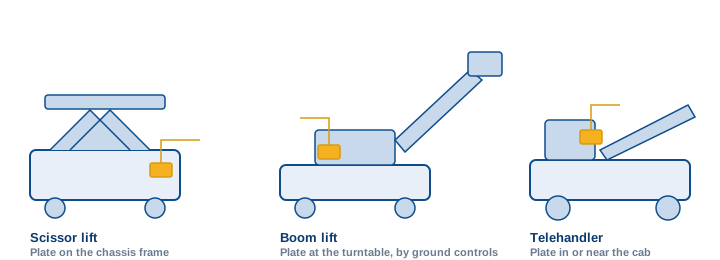
Serial numbers carry real weight on Lull equipment. Parts documentation specifies fitment by serial break, “prior to serial number X” or “serial number Y to present,” and Series II machines differ from their predecessors in more than the badge. On a machine this age, also expect the possibility that a previous owner substituted components: photos of what is actually on the machine, the part, its connections, its mounting, protect you from ordering what the catalog says should be there rather than what is.
Common Lull parts by system
Transfer carriage and boom components. The horizontal transfer mechanism is the machine’s signature and its most Lull-specific wear point: transfer cylinder and seal components, rollers, wear pads, and the hardware the sliding assembly rides on, plus conventional boom wear pads, extend and tilt cylinder parts, hoses, and fork carriage components. Slop or noise in the transfer or telescope usually means pads and rollers before it means structure.
Steering and axles. Tie rods, axial joints, steering cylinders and seal kits, axle seals and hubs, and differential components. These share fitment with SkyTrak and JLG machines of the era on several items, always resolved by serial number.
Drivetrain. Transmission components, shift selectors, drive shafts, and related seals and filters. On high-hour legacy machines, drivetrain symptoms deserve diagnosis before parts: worn mounts and linkages mimic more expensive failures.
Hydraulics. Pumps, valves, cylinders and seal kits, hoses, and fittings across lift, extend, tilt, transfer, and steer circuits. Reseal is the default first conversation for weeping cylinders on machines this age.
Engine and electrical. Filters, belts, alternators, starters, gauges, switches, and sensor replacements for the diesel engines, plus wiring repairs, which decades of vibration make routine. A filter set per machine and a habit of clean connections prevent most small downtime.
Cab, tires, and safety items. Seats, glass, mirrors, alarms, beacons, foam-filled and pneumatic tires in period-correct sizes, and decal sets. Inspections fail machines on unreadable decals and dead alarms regardless of how well the iron runs.
Should you use OEM or aftermarket Lull parts?
On a legacy machine the question shifts slightly: the first question is availability, and the second is fit. OEM through the JLG network remains the anchor for structural, hydraulic, drivetrain, and transfer carriage components, where serial-break documentation is the only reliable record. Quality aftermarket and remanufactured options are a legitimate and sometimes necessary part of keeping older machines alive, particularly for filters, electrical commodity items, seats, and tires. What matters is confirming fit against the serial number and being honest about which components are safety-critical. The AirWorx parts team works both channels and will say which is right for the component in question.
Is it worth keeping an old Lull running?
Usually, yes, and the math is straightforward. A sound frame and boom with a documented maintenance record justifies wear parts, reseals, and even a drivetrain repair, because the machine’s replacement is a five-figure decision and the transfer carriage capability is genuinely useful. The calculation changes when structural repairs enter the picture or when downtime frequency starts costing jobs. AirWorx sits on both sides of that decision honestly: the parts and service teams keep the machine running, the sales team handles new and used replacements, and rental coverage fills the gap either way. Ask for the straight assessment; you will get one.
Local Lull parts support in Indiana and Illinois
Branches in Indianapolis, Fort Wayne, and Warsaw cover Indiana, and Flora covers southern Illinois, with parts transfer between branches and service trucks available around the clock for on-site work. AirWorx services legacy telehandlers in the field regularly, so a Lull parts request lands with people who have had these exact machines apart. If a Lull is down during committed work, telehandler rental coverage from the same branches bridges the repair.
- Full model designation from the serial plate
- Complete serial number (from the plate or the frame stamp)
- Part number from the failed component, if a label or casting shows one
- Photos: the component, its connections, and its position on the machine
- The symptom in plain words: what the machine does and does not do
How to order Lull parts from AirWorx
Send the model including Series designation, the complete serial number, the part number if a label or casting shows one, photos of the actual component on the machine, and the symptom with its operating conditions. Once the part is confirmed, ask what belongs in the same order on a machine this age, seals, hardware, and adjacent wear items usually do, and record the confirmed part number with the serial in the machine’s file.
Frequently asked questions about Lull parts
Is Lull still in business?
Lull is no longer produced as a brand, but it belongs to the JLG family and parts support continues through the JLG network.
Can I still get parts for a Lull 644E-42 or 944E-42?
Yes. The common legacy models remain supported, and AirWorx sources OEM and quality aftermarket options for them.
What is the Lull transfer carriage?
The boom assembly slides horizontally, letting the operator place a load precisely without repositioning the machine. Its rollers, pads, and cylinder components are Lull-specific wear items.
Where is the serial number on a Lull telehandler?
On the data plate in or near the cab, and stamped into the frame if the plate is missing, which is common on older machines.
Do Lull and SkyTrak share parts?
Several steering, axle, and chassis components carry shared fitment across Lull, SkyTrak, and JLG telehandlers of the same era, always confirmed by serial number.
When does repairing an old Lull stop making sense?
When structural repair enters the picture or downtime starts costing jobs. Wear parts, seals, and even drivetrain work on a sound frame usually pencil out; AirWorx will give a straight assessment either way.
Keeping a Lull working? Send the model, serial number, photos of the component, and the symptom to the AirWorx parts team.
Read the Aerial Lift Parts guide · Back to Equipment Resources