JLG builds one of the widest equipment ranges in the aerial lift industry, which is exactly why “JLG parts” is never enough information to fill an order. A joystick for a 1930ES electric scissor has nothing in common with a boom wear pad for an 860SJ, and even two 450AJ booms from different years can take different control modules. This guide covers how the JLG line breaks down, how to identify parts precisely, and which components fail most often. AirWorx stocks and sources JLG parts from branches in Indianapolis, Fort Wayne, and Warsaw, Indiana, and Flora, Illinois.
To order the right JLG part: record the full model designation and complete serial number from the data plate, send a plain description of the symptom and photos, and use the serial number to determine which revision fits.
Which JLG machines does this guide cover?
JLG’s core families, and the ones AirWorx sees most in Indiana and Illinois fleets:
Articulating boom lifts. The knuckle booms, built for up-and-over reach: models like the 340AJ, 450AJ, 600AJ, and 800AJ, plus larger articulating platforms such as the 1250AJP. Many of these exist in multiple generations, including Series II variants, which is one reason serial numbers matter so much on this family.
Telescopic boom lifts. The straight-stick line: 400S, 460SJ, 600S, 660SJ, 800S, and 860SJ, extending up into the Ultra series (1200SJP, 1350SJP, 1500SJ, 1850SJ) for extreme height work. The J suffix indicates a jib, which brings its own pivot, cylinder, and hose components.
Electric scissor lifts. The ES series slab scissors, including the 1930ES, 2030ES, 2632ES, and 2646ES, along with the newer R and RS series and the E3 line. These are the machines where batteries, chargers, and control electronics dominate the parts conversation.
| Machine family | Example models |
|---|---|
| Articulating booms | 340AJ, 450AJ, 600AJ |
| Telescopic booms | 400S, 460SJ, 600S |
| ES scissors | 1930ES, 2030ES, 2632ES |
Rough terrain scissors. RT models built for outdoor ground, with dual-fuel or diesel engines, larger tires, and outrigger components the slab scissors do not have.
Telehandlers. JLG builds telehandlers under its own name and also owns the SkyTrak brand. If your machine says SkyTrak on the boom, our SkyTrak parts guide covers it in detail, and many components route through the same JLG parts system.
JLG also produces vertical mast lifts and low-level access machines. The identification principles below apply to all of them.
How do you identify the right JLG part?
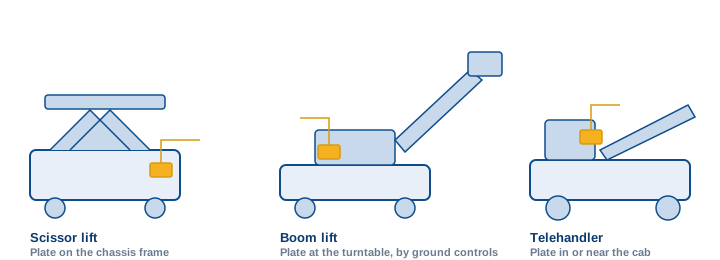
Start at the data plate. On JLG booms it sits on or near the turntable, placed to be readable from the ground control station. On ES scissors it is on the chassis, typically near the ladder or ground controls. Record the full model designation and the complete serial number. If the plate is unreadable, JLG stamps the serial into the frame; a parts specialist can tell you where for your specific family.
The serial number does the heavy lifting because JLG revises machines mid-production. A control module, hydraulic fitting, or harness can change at a serial break while the model name stays the same, and Series II machines differ from their first-generation namesakes in more than the badge. This is why a request like “switch for a JLG lift” nearly always turns into a follow-up question, and why a complete serial number usually turns into a same-call answer.
If you know the failed component’s own part number, from a label or casting, include it, along with photos showing the component, its connectors, and its position on the machine. For hoses, photograph both end fittings and note the length and routing.
Common JLG parts by system
Controls and electronics. Platform joystick controllers, ground and platform control modules, membrane panels, foot switches, limit and proximity switches, and harnesses. JLG’s electronic control architecture links the platform box and ground module, so symptoms that look like a dead joystick sometimes trace to the module, a connector, or an interlock instead. Fault codes from the machine’s diagnostic display, recorded before you call, shorten this diagnosis dramatically. Rule out battery state, fuses, and corroded plugs before committing to a costly module.
Boom components. Wear pads between telescoping sections are the signature boom consumable; noise, slop, or chatter in the telescope usually means pads before it means structure. Boom cables, sheaves, jib pivot components, and platform rotator and leveling parts round out the list on S and AJ machines.
Hydraulics. Lift, steer, and telescope cylinders and their seal kits, drive pumps and motors, valves, hoses, and fittings. A weeping cylinder often needs a seal kit rather than replacement, and a recurring hose failure points at routing or clamping, not bad luck.
Batteries and charging on ES machines. Deep-cycle battery sets, on-board chargers, contactors, and cables. Chargers are voltage and chemistry specific. Watering, clean terminals, and full charge cycles decide whether a battery set lasts its rated life, so charger and battery problems on an ES scissor are as often maintenance findings as parts failures.
Filters, engine, and consumables. Air, oil, fuel, and hydraulic filters across the engine-powered line, belts and engine sensors on diesel and dual-fuel booms and RT scissors, plus tires in solid, foam-filled, and non-marking options, brake components, and complete decal sets by model and serial range.
Should you use OEM or aftermarket JLG parts?
For JLG electronics, structural components, and anything safety-critical, OEM is the sensible default: the serial-range revisions are exactly the kind of detail aftermarket catalogs blur, and the documentation stays aligned with JLG’s illustrated parts manuals for future service. For filters, batteries, some tires, and general hardware, quality aftermarket options can be reasonable. The honest answer varies by component and machine duty, and the AirWorx parts team will say so rather than defaulting to one answer for everything.
Local JLG parts support in Indiana and Illinois
Searches for “JLG parts near me” are usually about downtime, not distance. What local support actually buys you is a parts specialist who asks the right questions before the order goes in, stock that can transfer between branches, and a service department behind the counter when the diagnosis is not clear.
AirWorx covers the Indianapolis metro from the home branch, northeast Indiana from Fort Wayne, north-central Indiana from Warsaw, and southern Illinois from Flora. The company rents and sells JLG equipment, stocks parts for it, and services it in the field, with factory-trained technicians and service trucks available around the clock, so parts requests connect to real machine knowledge, not just a catalog. If a JLG machine is down during committed work, rental coverage from the same branches bridges the repair.
- Full model designation from the serial plate
- Complete serial number (from the plate or the frame stamp)
- Part number from the failed component, if a label or casting shows one
- Photos: the component, its connections, and its position on the machine
- The symptom in plain words: what the machine does and does not do
How to order JLG parts from AirWorx
Send the parts team the model, serial number, part number if you have it, a plain description of the symptom, and photos. Distinguish the symptom from your suspected fix: “platform controls intermittently lose power” gives the specialist more to work with than “need a controller,” and it protects you from buying a part that was not the problem.
Once the part is confirmed, ask what belongs in the same order: seal kits, fasteners, filters, or the wear item behind the failure. Keep the confirmed part number and serial number with the machine’s maintenance record so the next order starts from a known machine.
Frequently asked questions about JLG parts
What information should I provide when ordering JLG parts?
The full model designation, the complete serial number, the part number if known, a plain-language symptom description, and photos of the component and its connections.
Where is the serial number on a JLG boom lift?
On the data plate at the turntable, near the ground control station. If the plate is missing or unreadable, the serial is stamped into the frame.
Are JLG parts interchangeable between models?
Not reliably, and often not even within one model across serial ranges. JLG revises components mid-production, so compatibility should be confirmed by serial number before ordering.
Does AirWorx carry parts for SkyTrak telehandlers?
Yes. SkyTrak is a JLG brand, and AirWorx supports it fully. See the SkyTrak parts guide for model-specific detail.
Should I choose OEM or aftermarket JLG parts?
OEM for electronics, structural, and safety-critical components; aftermarket can be reasonable for filters, batteries, and commodity wear items. The right call depends on the component and how the machine works.
Can AirWorx help if I cannot identify the failed part?
Yes. Send photos and the data plate information, and if it still is not conclusive, AirWorx service can diagnose the machine at a branch or on site and order from a confirmed diagnosis.
Need help identifying a JLG part? Send the model, serial number, component details, and photos. A complete request is the fastest route to a confident match.
Read the Aerial Lift Parts guide · Back to Equipment Resources