Skyjack scissor lifts are famous among mechanics for one design decision: the control system is relay-based with color coded, numbered wiring instead of a network of electronic modules. Black wire number 14 is the lift function on a Skyjack scissor, and it means the same thing on a Skyjack boom. That philosophy makes these machines unusually field-diagnosable, and it shapes how parts requests for them work. This guide covers the SJIII line, how to identify parts precisely, and which components commonly need replacing. AirWorx carries Skyjack and supports it from branches in Indianapolis, Fort Wayne, and Warsaw, Indiana, and Flora, Illinois.
To order the right Skyjack part: record the full model designation and serial number from the chassis plate, describe exactly what the machine does and does not do, and send photos of the component, its connections, and its location.
Which Skyjack machines does this guide cover?
Electric slab scissors. The SJIII DC line: models like the SJIII 3215, 3219, 3220, 3226, 4626, and 4632. The model number decodes directly: the first two digits are chassis width in inches and the last two are platform height in feet, so an SJIII 4632 is 46 inches wide with a 32 foot platform height. These are 24V machines with proportional drive and lift controls, dual holding brakes, pothole protection, and solid non-marking tires, built for slab and finished-floor work.
| Model | Chassis width | Platform height |
|---|---|---|
| SJIII 3219 | 32 in | 19 ft |
| SJIII 3226 | 32 in | 26 ft |
| SJIII 4632 | 46 in | 32 ft |
Rough terrain scissors. Skyjack’s engine-powered RT line adds four wheel drive components, outrigger and leveling systems, and diesel or dual-fuel engine parts to the picture.
Skyjack also builds vertical mast lifts, boom lifts, and telehandlers on the same control philosophy, so the diagnostic logic below carries across the brand.
Why Skyjack’s control system changes the parts conversation
Most modern lifts route functions through electronic control modules on a network, which means electrical symptoms often end in a module swap and a software question. Skyjack’s SJIII scissors instead use a relay-based analog system with the SKYCODED wiring scheme: every wire has a color and a number, and each function’s circuit can be traced with a multimeter and the schematic. No multiplexing, no CANbus modules on these machines.
Practically, that means two things for parts. First, diagnosis is cheaper: a technician can prove whether the fault is a switch, a relay, a contactor, or the wiring itself before anything is ordered. Second, the parts that fix Skyjack electrical problems are usually small and inexpensive, relays, switches, contactors, wiring repairs, rather than large control modules. It is one reason these machines are so common in rental fleets, and it rewards sending a precise symptom description with your parts request.
How do you identify the right Skyjack part?
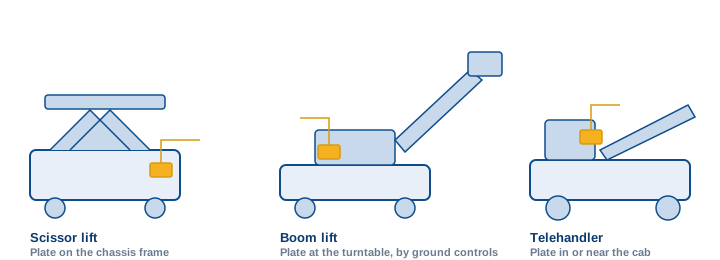
Record the full model designation and serial number from the serial plate on the chassis; if the plate is gone, the serial is stamped into the frame. Skyjack revises machines across serial ranges like every manufacturer, so the serial number, not the model alone, confirms which relay panel, control box, or harness fits. Include the failed component’s own part number when it is readable, plus photos of the component, its connections, and its location.
For electrical symptoms specifically, note exactly what the machine does and does not do: which functions work from the ground station versus the platform, whether the machine drives at height, and what the alarms are doing. On a relay-based machine, that pattern often identifies the failed circuit before the box is even opened.
Common Skyjack scissor lift parts by system
Controls and electrical. Platform control boxes and joysticks, ground control switches, relays and contactors, limit switches, tilt sensors and alarms, battery disconnects, and harness repairs. Joystick assemblies wear at their potentiometers and springs, and membrane panels fail from punctures and water. Because the system is analog, always test the cheap circuit components before replacing an assembly.
Batteries and charging. The 24V DC machines depend on their deep-cycle battery sets and on-board chargers, with low voltage protection built in. Runtime complaints trace to battery condition and charging habits as often as to failed hardware, so load-test before replacing.
Hydraulics. Lift cylinders and seal kits, pumps, manifold valves and coils, hoses, and fittings. Drift and slow lift usually mean seals or a valve, not a pump.
Scissor stack and deck. Arm pins and bushings, slide blocks, roll-out extension deck rollers and latches, entry and rail hardware, and pothole guard mechanisms. High-hour rental machines wear these on schedule, and annual inspections find them.
Drive and chassis. Hydraulic drive components, dual holding brake parts, steer components, wheel hardware, and solid non-marking tires on the slab machines. RT models add drivetrain, engine, and outrigger components.
Decals and safety items. Complete decal sets by model and serial range, alarms, flashing beacons, and lanyard attachment hardware. Machines fail inspections on unreadable decals, so these are real parts, not afterthoughts.
Should you use OEM or aftermarket Skyjack parts?
For control boxes, structural components, cylinders, and safety systems, OEM keeps the machine aligned with Skyjack’s schematics and serial-range documentation, which is worth a premium on a machine whose whole appeal is traceable simplicity. Relays, switches, batteries, filters, and tires are where quality aftermarket options can make sense, provided specifications match. When electronic control components are involved, exact replacements avoid compatibility surprises. The AirWorx parts team will give a straight answer per component rather than one policy for everything.
Local Skyjack parts support in Indiana and Illinois
AirWorx carries Skyjack in its fleet, so the parts counter is backed by technicians who troubleshoot these exact relay systems routinely. Branches in Indianapolis, Fort Wayne, and Warsaw cover Indiana, and Flora covers southern Illinois, with parts transfer between branches and service trucks available around the clock for on-site diagnosis and repair. If a Skyjack scissor is down during committed work, rental coverage from the same branches bridges the repair.
- Full model designation from the serial plate
- Complete serial number (from the plate or the frame stamp)
- Part number from the failed component, if a label or casting shows one
- Photos: the component, its connections, and its position on the machine
- The symptom in plain words: what the machine does and does not do
How to order Skyjack parts from AirWorx
Send the model, full serial number, part number if known, photos, and a symptom description that says what works and what does not, from both control stations. On these machines that pattern is diagnostic gold. Once the part is confirmed, ask what belongs in the same order, and file the confirmed part number with the machine’s maintenance record so the next request starts from a known machine.
Frequently asked questions about Skyjack scissor lift parts
What do Skyjack SJIII model numbers mean?
The first two digits are chassis width in inches and the last two are platform height in feet. An SJIII 3219 is 32 inches wide with a 19 foot platform height.
What makes Skyjack electrical systems different?
SJIII scissors use a relay-based analog control system with color coded, numbered wiring instead of networked electronic modules. Faults can be traced by circuit, which makes diagnosis faster and repairs cheaper.
Where is the serial number on a Skyjack scissor lift?
On the serial plate on the chassis, with the number stamped into the frame if the plate is missing or damaged.
Are Skyjack parts interchangeable between models?
Many small electrical components recur across the line, but fitment still follows the model and serial range. Confirm by serial number before ordering.
Should I choose OEM or aftermarket Skyjack parts?
OEM for control boxes, cylinders, structural, and safety components; quality aftermarket can be reasonable for relays, switches, batteries, filters, and tires when specifications match.
Can AirWorx diagnose a Skyjack electrical fault before I buy parts?
Yes. Describe which functions work from each control station, or have AirWorx service trace the circuit at a branch or on site, then order from the confirmed diagnosis.
Need a Skyjack part identified? Send the model, serial number, symptom pattern, and photos to the AirWorx parts team.
Read the Aerial Lift Parts guide · Back to Equipment Resources